


If you menstruate and notice your voice shifting around your period, you’re not alone. Changes in your singing voice around that time are very common. This guide covers what many singers notice, practical ways to adapt your practice and performances, and how to plan around your own pattern.
It focuses on the menstrual cycle in estrogen-dominant singers. Any major hormonal change, including those from some medical conditions, hormonal birth control, gender-affirming hormones, pregnancy, or menopause, can affect your voice too. For anything beyond managing your singing, talk to your doctor about how hormonal changes affect your body and which options suit you.
Key takeaways
- Voice changes around your period are common; many singers describe a voice that feels sluggish or swollen.
- Extra hydration and steam help many singers feel more comfortable.
- Singing more lightly and leaning on breath support helps on those days.
- A simple voice journal shows your own pattern, so you can plan practice and performances around it.
What many singers notice
Around their period, many singers describe their voice as sluggish, swollen, or less reliable than usual. You might find fast passages harder, your range a little different, or your tone less consistent. Shifts in hydration and fluid retention around that time are a likely part of the picture. Everyone is different, so your experience may be more or less noticeable than that of other singers you know.
Hydration and steam
You can’t switch these changes off, but focusing on hydration helps many singers. Drink a little more water than usual in the days around your period. Steam can also help if your voice feels dry on the surface: try a hot shower or a personal steamer, and many singers enjoy warm herbal teas. If you’re considering supplements or other remedies, ask your doctor first.
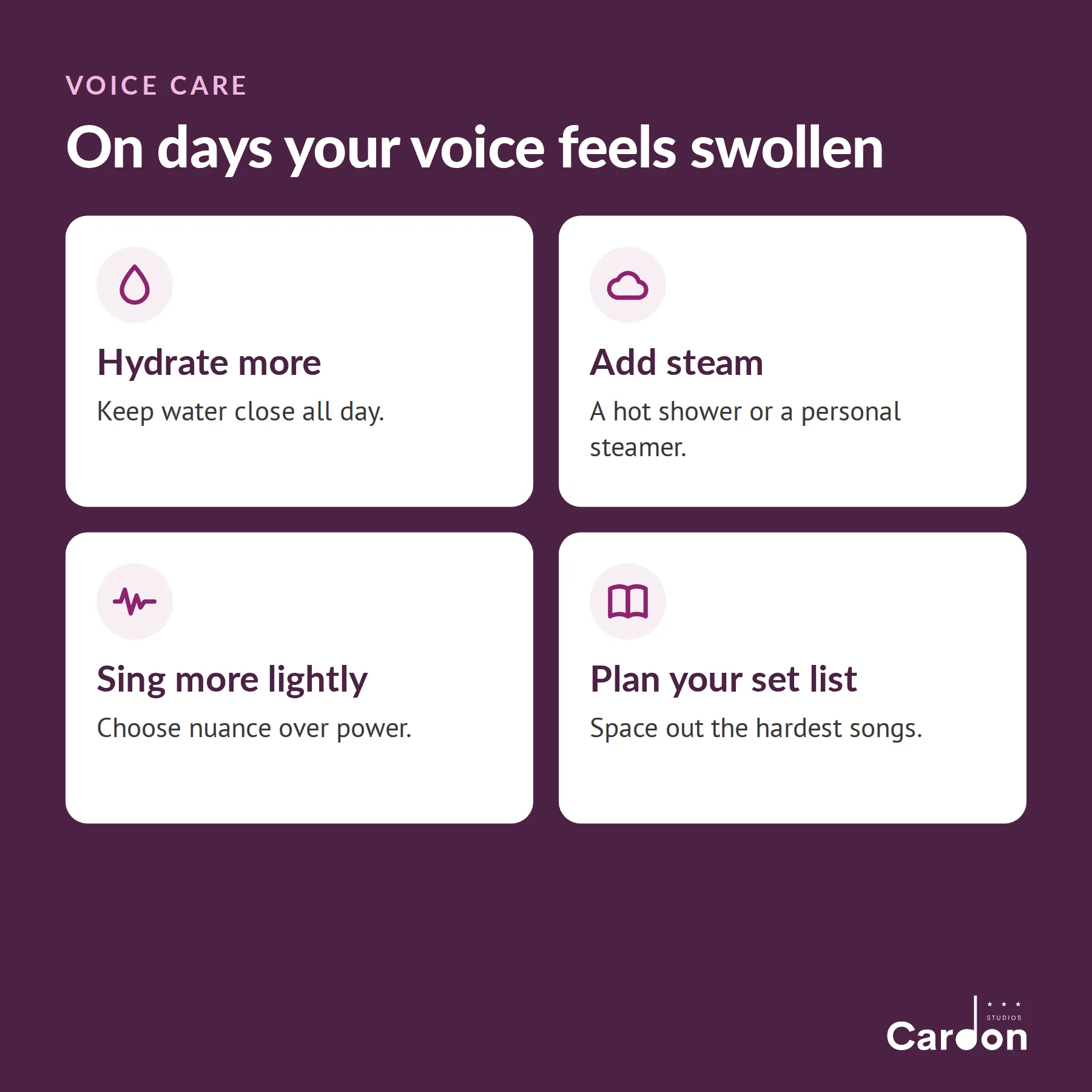
- Hydrate more: keep water close all day.
- Add steam: a hot shower or a personal steamer.
- Sing more lightly: choose nuance over power.
- Plan your set list: space out the hardest songs.
Adjust your technique on those days
Small changes to your usual technique can make your voice feel steadier. Sing more lightly than you ordinarily would; this probably isn’t the day for your highest belt or most powerful singing. Instead, look for chances to sing with nuance. Depending on your symptoms, double down on your breath support, which can be hard if you’re dealing with cramps but helps keep your singing comfortable, and focus on consistent tone throughout your range. A voice that feels swollen, like a voice under the weather, calls for a gentler approach. Our primer on breath support can help.
Plan your practice and performances
If you perform regularly, pay attention to what feels different at different points in your cycle. Are faster passages harder? Does your range shift slightly? Knowing where you’re likely to struggle lets you plan ahead:
- Avoid placing two challenging songs back to back in a set.
- Save your energy for the song that needs it most.
- Drop or swap a song that doesn’t work at that time of the month.
- Consider a lower key, or lower songs, which some singers find easier on those days.
- If it really doesn’t fit, it’s OK to turn down a gig.
Keep a voice journal
Singing through your cycle takes a bit more self-knowledge than you might expect, but a little goes a long way. Charting how your voice feels shows you your own pattern, which is far more useful than general advice.
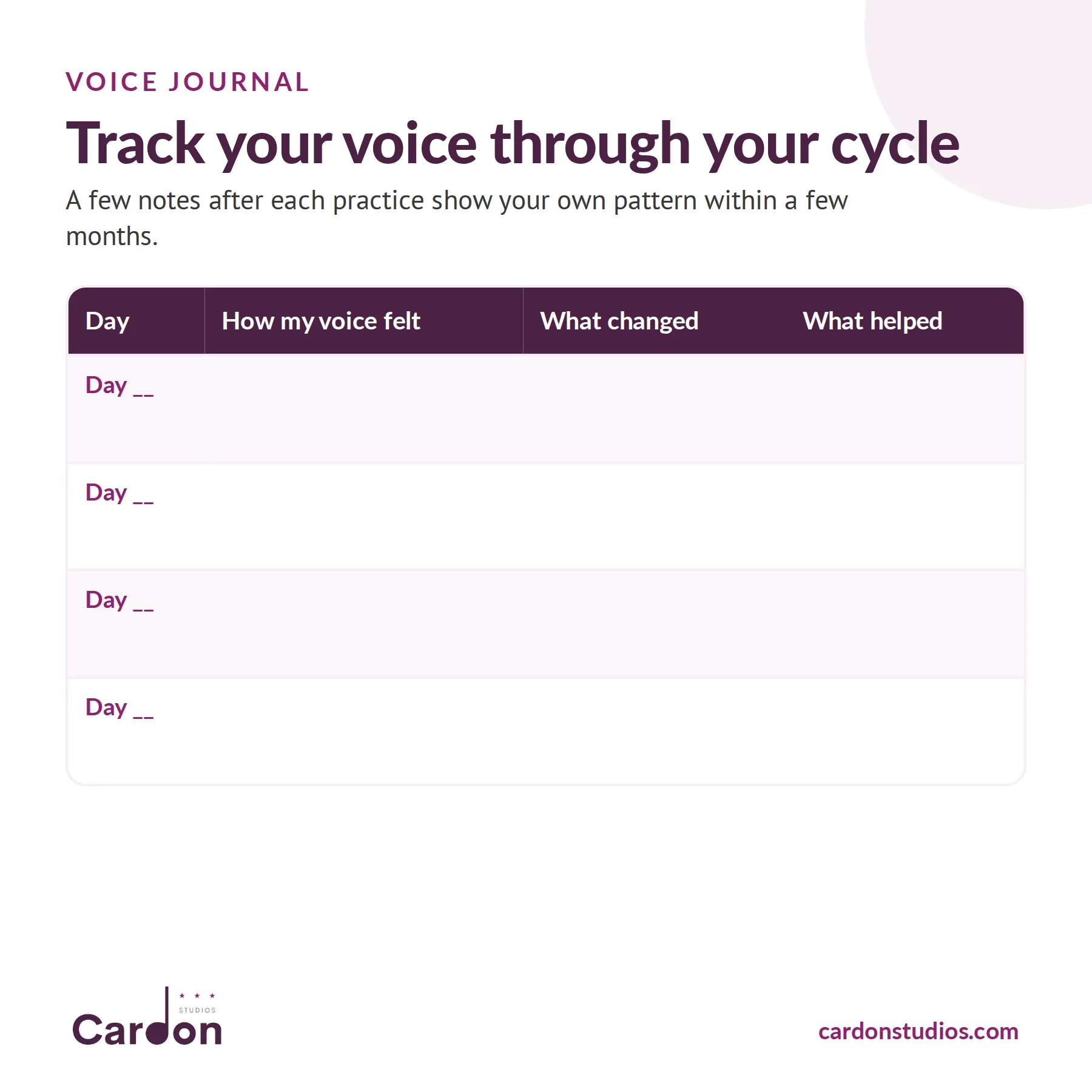
- Note the day of your cycle each time you practice.
- Write how your voice felt in a few words.
- Note what changed, such as range, agility, or tone.
- Note what helped, such as extra water, steam, or lighter singing.
- Look for your pattern after a few cycles, and plan your practice and gigs around it.
Talk about it with your teacher or director
It can feel awkward to bring up, but telling your voice teacher, choir director, or music director that your voice varies across the month helps them help you. A teacher can plan lighter technical work for those days and save new high or heavy material for when your voice feels its best. A director may be able to adjust which songs you rehearse hardest, or when you take a solo. You don’t need to share details; “my voice is less reliable a few days a month” is enough. Your voice journal makes these conversations easier, because you can point to what you’ve actually noticed.
Pregnancy, menopause, and other changes
Bigger hormonal shifts, such as pregnancy and menopause, can bring larger changes to your singing voice, and again, everyone’s experience is different. For a deeper look at this topic, we recommend the book Singing Through Change by Nancy Bos, Joanne Bozeman, and Cate Frazier-Neely.
When to talk to a doctor
If voice changes are severe, don’t follow a clear pattern, or come with pain, talk to your doctor. An ear, nose, and throat doctor (ENT) can examine your voice if needed.
From the studio
A teacher can help you adapt your technique and song choices to how your voice feels on a given day. Share what you’ve noticed in your lessons, and between lessons you can send a video for a personalized response within 72 hours.
Online voice lessons
Plan your singing around your voice
One monthly membership includes four private online voice lessons, one video coaching submission, the Learning Library, and member online events, with a teacher matched to your style, goals, age, and schedule.
Common questions about singing through your cycle
Does your period affect your singing voice?
For many singers, yes. Around their period, many describe their voice as sluggish or swollen, with less reliable agility, range, or tone. The degree varies a lot from person to person.
What helps my voice during my period?
Extra hydration, steam, lighter singing, and strong breath support help many singers. Planning your practice and set lists around your own pattern helps too.
Should I avoid performing during my period?
Not necessarily. Many singers perform comfortably by singing more lightly and arranging their set list with care. A voice journal helps you know what to expect from your own voice.