


Yes, you can sing on your period. Many singers find their voice feels heavier or harder to control for a few days, and singers in a 2009 study rated their voice quality lower on days 1 to 3 than the rest of the cycle. Warm up gently, sing lightly, keep water close, and track your pattern in a voice journal.
If you menstruate and notice your voice shifting around your period, you’re not alone. This guide covers what many singers notice, what research says, practical ways to adapt your practice and performances, and how to plan around your own pattern.
It focuses on the menstrual cycle in estrogen-dominant singers. Any major hormonal change, including those from some medical conditions, hormonal birth control, gender-affirming hormones, pregnancy, or menopause, can affect your voice too. For anything beyond managing your singing, talk to your doctor about how hormonal changes affect your body and which options suit you.
Key takeaways
- Voice changes around your period are common; many singers describe a voice that feels sluggish or swollen.
- Extra hydration and steam help many singers feel more comfortable.
- Singing more lightly and leaning on breath support helps on those days.
- A simple voice journal shows your own pattern, so you can plan practice and performances around it.
Does your voice change on your period? What singers notice
Around their period, many singers describe their voice as sluggish, swollen, or less reliable than usual. You might find fast passages harder, your range a little different, or your tone less consistent. Shifts in hydration and fluid retention around that time are a likely part of the picture. Everyone is different, so your experience may be more or less noticeable than that of other singers you know.
Does your period affect your singing voice? What research says
Research on singers and the menstrual cycle is small, but it lines up with what many singers describe. In a 2009 study in the Journal of Voice, Maree Ryan and Dianna Kenny asked conservatory singing students to keep daily diaries. The singers rated their voice quality lower on the first three days of their period than on the rest of the cycle, and lower voice ratings went along with lower mood.
The researchers also recorded the six singers who noticed the biggest changes, once on the first day of their period and once mid-cycle. The singers said the sound took more effort during their period, but expert listeners couldn’t hear a difference between the recordings. That’s reassuring: your voice may feel harder to use on those days without sounding worse to your audience.
Lab measurements are less clear. A 2020 study from Auburn University tracked hormone levels and voice measures across the cycle in 15 women and found no significant differences in pitch or voice quality measures between phases, though the authors note their measures may not have been sensitive enough to pick up hormone-related changes. The same paper describes earlier clinical reports of a “premenstrual vocal syndrome” in some women, including swelling of the vocal folds. Put together, changes are real for many singers, they vary a lot from person to person, and your own notes are the best guide.
Hydration and steam
You can’t switch these changes off, but focusing on hydration helps many singers. Drink a little more water than usual in the days around your period. Steam can also help if your voice feels dry on the surface: try a hot shower or a personal steamer, and many singers enjoy warm herbal teas. If you’re considering supplements or other remedies, ask your doctor first.
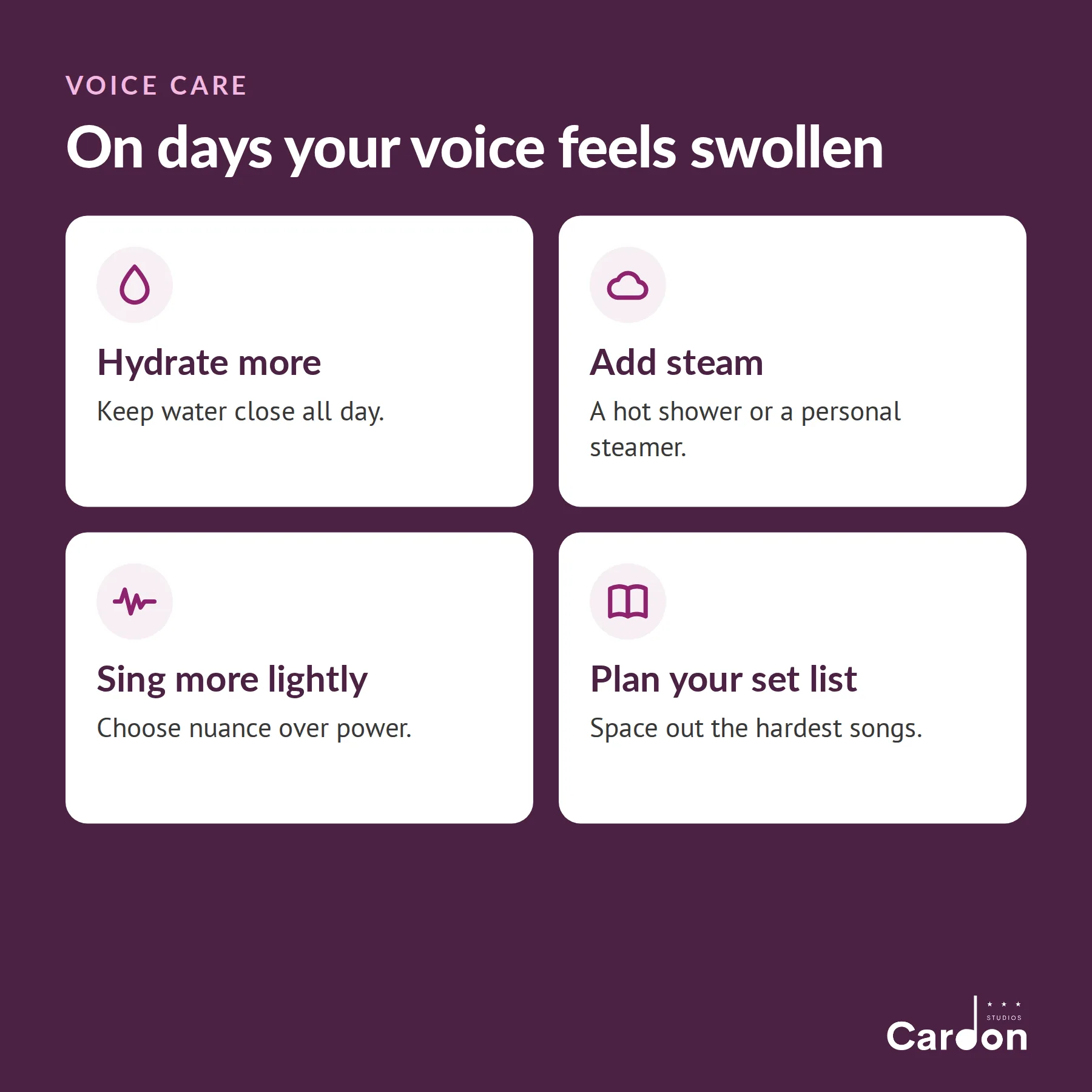
- Hydrate more: keep water close all day.
- Add steam: a hot shower or a personal steamer.
- Sing more lightly: choose nuance over power.
- Plan your set list: space out the hardest songs.
How to sing on your period: adjust your technique
Small changes to your usual technique can make your voice feel steadier. Sing more lightly than you ordinarily would; this probably isn’t the day for your highest belt or most powerful singing. Instead, look for chances to sing with nuance. Depending on your symptoms, double down on your breath support, which can be hard if you’re dealing with cramps but helps keep your singing comfortable, and focus on consistent tone throughout your range. A voice that feels swollen, like a voice under the weather, calls for a gentler approach. Our primer on breath support can help.
How do singers deal with periods? A gentle practice plan
You don’t have to stop singing for your period. You can adjust how you practice instead. On days when your voice feels heavy or slow to respond, this plan keeps you working without pushing.
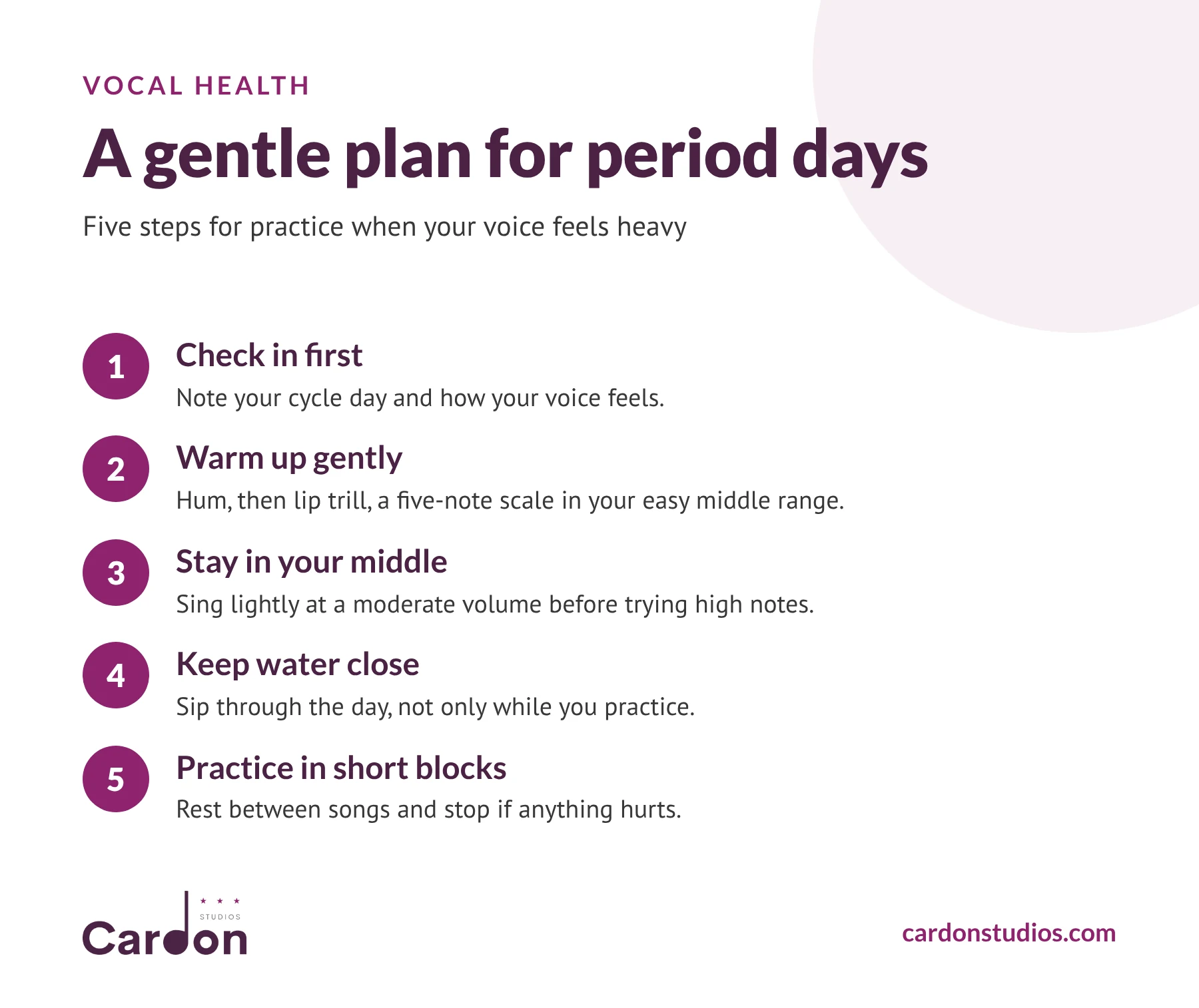
- Check in first. Before you sing, note your cycle day and how your voice feels in your voice journal.
- Warm up longer and more gently. Hum a five-note scale (1-2-3-4-5-4-3-2-1) on “mm,” then sing the same pattern as lip trills, five times each, starting in your easy middle range and moving up only as far as it feels comfortable.
- Stay in your comfortable middle. Sing through your songs lightly at a moderate volume first, and add high notes or belting only if they feel easy.
- Keep water close. Sip through the day, not just while you practice. A review of hydration research found that dehydration, both in the body and on the surface of the vocal folds, is bad for how the vocal folds work.
- Practice in shorter blocks. Rest your voice between songs, and stop if anything hurts or your voice turns hoarse.
If cramps make deep breathing uncomfortable, practice sitting tall in a chair, and spend more time on the parts of practice that don’t need full power: learning the words and rhythms, listening to your recordings, and marking through a song lightly. Save new or demanding songs for days when your voice feels its best.
How do singers perform on their period? Plan ahead
If you perform regularly, pay attention to what feels different at different points in your cycle. Are faster passages harder? Does your range shift slightly? Knowing where you’re likely to struggle lets you plan ahead:
- Avoid placing two challenging songs back to back in a set.
- Save your energy for the song that needs it most.
- Drop or swap a song that doesn’t work at that time of the month.
- Consider a lower key, or lower songs, which some singers find easier on those days.
- If it really doesn’t fit, it’s OK to turn down a gig.
Want a teacher’s ear on your voice? Cardon Studios teaches private online voice lessons for singers ages 10 and up, live over Zoom with a teacher matched to your style and goals. See how lessons work
Keep a voice journal
Singing through your cycle takes a bit more self-knowledge than you might expect, but a little goes a long way. Charting how your voice feels shows you your own pattern, which is far more useful than general advice.
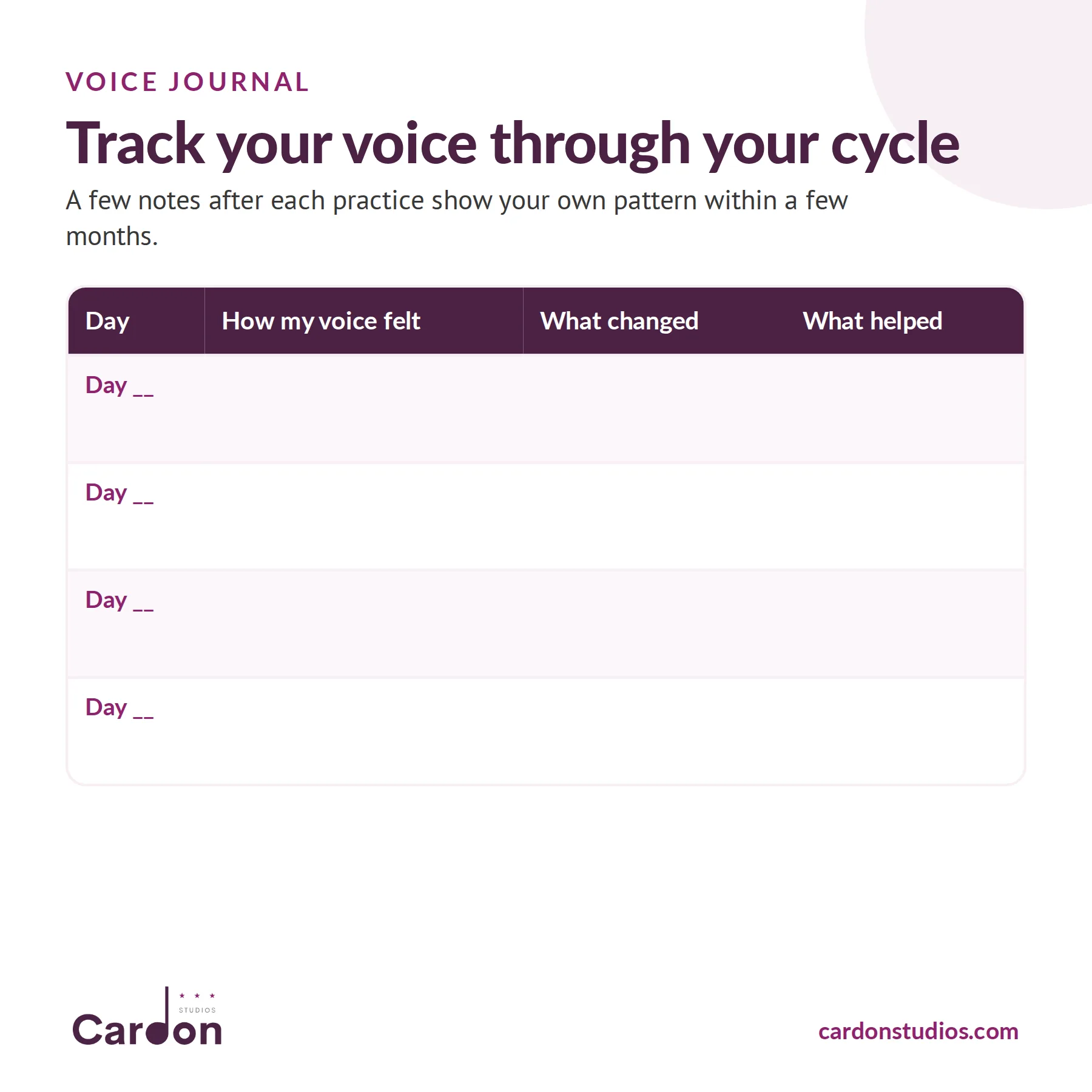
- Note the day of your cycle each time you practice.
- Write how your voice felt in a few words.
- Note what changed, such as range, agility, or tone.
- Note what helped, such as extra water, steam, or lighter singing.
- Look for your pattern after a few cycles, and plan your practice and gigs around it.
Talk about it with your teacher or director
It can feel awkward to bring up, but telling your voice teacher, choir director, or music director that your voice varies across the month helps them help you. In one-on-one voice lessons, a teacher can plan lighter technical work for those days and save new high or heavy material for when your voice feels its best. A director may be able to adjust which songs you rehearse hardest, or when you take a solo. You don’t need to share details; “my voice is less reliable a few days a month” is enough. Your voice journal makes these conversations easier, because you can point to what you’ve actually noticed.
Pregnancy, menopause, and other changes
Bigger hormonal shifts, such as pregnancy and menopause, can bring larger changes to your singing voice, and again, everyone’s experience is different. For a deeper look at this topic, we recommend the book Singing Through Change by Nancy Bos, Joanne Bozeman, and Cate Frazier-Neely.
When to talk to a doctor
If voice changes are severe, don’t follow a clear pattern, or come with pain, talk to your doctor. An ear, nose, and throat doctor (ENT) can examine your voice if needed. For everyday voice care, see our vocal health guide.
From the studio
A teacher can help you adapt your technique and song choices to how your voice feels on a given day. Share what you’ve noticed in your lessons, and between lessons you can send a video for a personalized response within two business days.
Online voice lessons
Plan your singing around your voice
One monthly membership includes four private online voice lessons, one video coaching submission, the Learning Library, and member online events, with a teacher matched to your style, goals, age, and schedule.
Common questions about singing on your period
Does your period affect your singing voice?
For many singers, yes. Around their period, many describe their voice as sluggish or swollen, with less reliable agility, range, or tone. The degree varies a lot from person to person.
Can you sing on your period?
Yes, you can keep singing on your period. Your voice may feel heavier or take more effort for a few days, so warm up gently, sing more lightly, and stop if anything hurts. If you have pain, lasting hoarseness or voice changes that worry you, talk to your doctor.
What helps my voice during my period?
Extra hydration, steam, lighter singing, and strong breath support help many singers. Planning your practice and set lists around your own pattern helps too.
How do singers perform on their period?
Many plan around it. They warm up gently, sing more lightly, keep water nearby, and space out their hardest songs in the set list. A voice journal helps you know what to expect from your own voice, so you can plan before the day comes.
Does singing help with period cramps?
We haven’t found research showing that singing relieves period cramps. For the cramps themselves, MedlinePlus lists self-care steps such as a heating pad on your lower belly, warm drinks, light exercise and relaxation techniques like yoga. If your cramps are severe or don’t improve, talk to your doctor.