

It’s difficult to overstate how important breathing is to singing (or speaking!). If we break singing down to its simplest parts, it rests on two pillars: controlled intake and release of breath, and carefully shaping the vocal tract to create the sound you want. When the breathing system is working efficiently, the vocal folds come together and create sound (phonation) largely without your conscious thought.
It may surprise you how few nerve endings exist inside your voice box. You can’t really feel your vocal folds at all. Anything you perceive as coming from your “voice” is more likely related to how you’re using your breath, or how you’re shaping the space around and above your voice box up to your mouth: your vocal tract.
Key takeaways
- Good breath support keeps the work low in your body, never in your throat or shoulders.
- Start with posture: a lifted sternum and loose, floating shoulders make room for a full breath.
- Every breath is diaphragmatic; aim for breaths that feel low and wide rather than tall and narrow.
- Three exercises build the habit: the circle breath stretch, hissing for different lengths, and lip trills.
Why breathing to sing feels different
Breathing is a largely involuntary function, and day to day we breathe to survive, not to make art. Singing (and, to a lesser degree, speaking) asks for long, controlled exhales compared to our inhales, which can feel awkward at first. Drawing your attention to a few specific movements and sensations makes it feel much more natural.
When you take a full, deep breath, your chest cavity expands a great deal. Your ribs are hinged on your spine, and the intercostal muscles between them lift the ribs open and out, making room for an open “barrel” breath. That’s the goal.
Start with posture
Before looking for that barrel breath, adjust your posture. Slumping forward keeps your chest cavity from expanding, so you’ll want your sternum lifted and your shoulders relaxed. If someone tells you to “sit up straight,” you might jerk your shoulders back and create tension that’s hard to hold. Instead, raise your arms straight up beside your ears, then slowly lower them out to the sides and down, letting them hang from loosely floating shoulders. You’ll likely notice your sternum is lifted and your shoulder blades are free. Your teacher may ask you to imagine your shoulder blades dripping down your back; that’s the feeling to aim for. Our article on alignment has more on finding an easy, balanced posture.
What “diaphragmatic breathing” really means
If you’ve heard the phrase “diaphragmatic breath” and puzzled over what it looks like, you’re not alone. In fact, all breaths are diaphragmatic. The diaphragm is the primary muscle of inhalation. From its cupped position beneath your lungs, it forms a barrier between your lungs and the other organs in your trunk. It’s connected to your lowest ribs all the way around, so you can think of it as a platform to “support” from. Your teacher may use different words, but the goal is always the same: keep the work in this general area, not up around your shoulders and throat.
At rest, after you’ve breathed out, the diaphragm is shaped like an upside-down cup. When you breathe in, it contracts and flattens, which changes the air pressure in your chest so that air flows into your lungs. Any sucking or gasping feeling is extra effort you don’t need. When this movement is exaggerated, you may even notice your belly move outward. Your front abdominal muscles shouldn’t squeeze. Think “short and wide” breaths rather than “tall and narrow” gasps, where the shoulders rise and the abs clench. If you want to pinpoint where the work happens, look to your obliques and transverse abdominis: the engagement should feel more like the flex you feel when you cough or laugh than like doing a crunch.
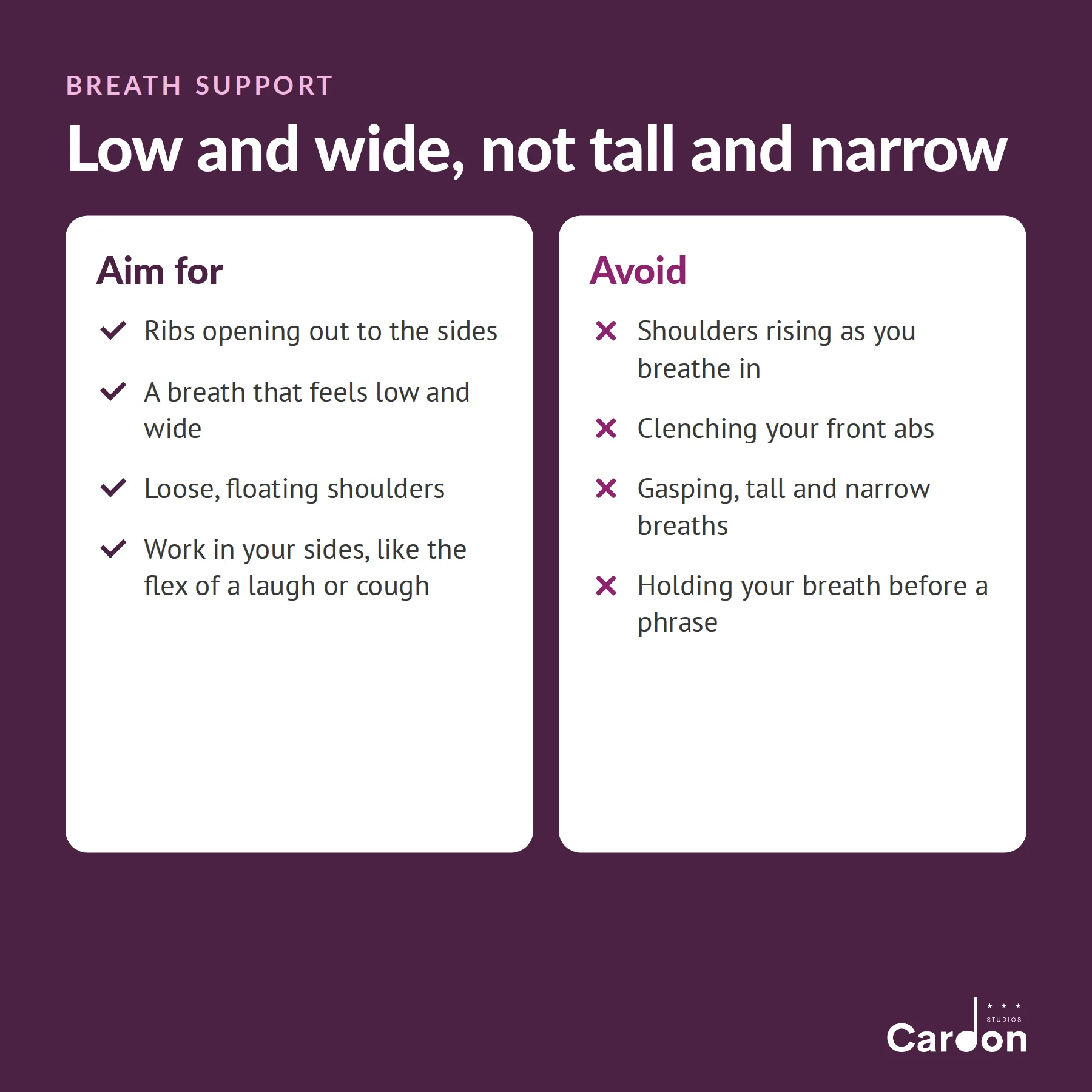
| Aim for | Avoid |
|---|---|
| Ribs opening out to the sides | Shoulders rising as you breathe in |
| A breath that feels low and wide | Clenching your front abs |
| Loose, floating shoulders | Gasping, tall and narrow breaths |
| Work in your sides, like the flex of a laugh or cough | Holding your breath before a phrase |
Different styles, different kinds of support
Different styles of singing talk about “breath support” in different ways. The bel canto ideal of appoggio means leaning into the expansion of your intercostal muscles and resisting letting your ribs close back down until the very end of the phrase. It’s essential for opera singing and may be more than the average pop or contemporary singer needs, but it doesn’t hurt to experiment.
Contemporary singers who mostly sing with a microphone often need less than this, and some get tripped up by over-breathing. If that sounds familiar, notice where you feel tension, such as a tight belly at the ends of phrases or a tight neck and jaw on big intervals, and adjust your breathing from there.
Every body is different, so finding what works for you is key. The one true rule is to keep the work lower in your body, never around your throat or shoulders. Visualization can help: imagine drawing your breath all the way down to your hips, or picture the cartilage between your bones as spacers keeping you floating and open. It may sound odd, but for some singers these images are exactly what makes it click.
Keep the breath moving
Efficiency comes from staying in motion. Once you breathe in, you breathe out, and the cycle continues. Make it your job to notice and avoid moments of holding your breath.
Try this: take a deep breath and hold it. When you let go, do you get a steady, even flow of air, like you want for long phrases? Or a rush of air leaving all at once? With conscious control you may be able to release slowly, but in the heat of a performance or recording, you don’t want that much attention on your breath. Instead, aim to make a consistent, easy flow of air the default for your voice. Building healthy habits is the name of the game.
Breathing exercises to add to your practice
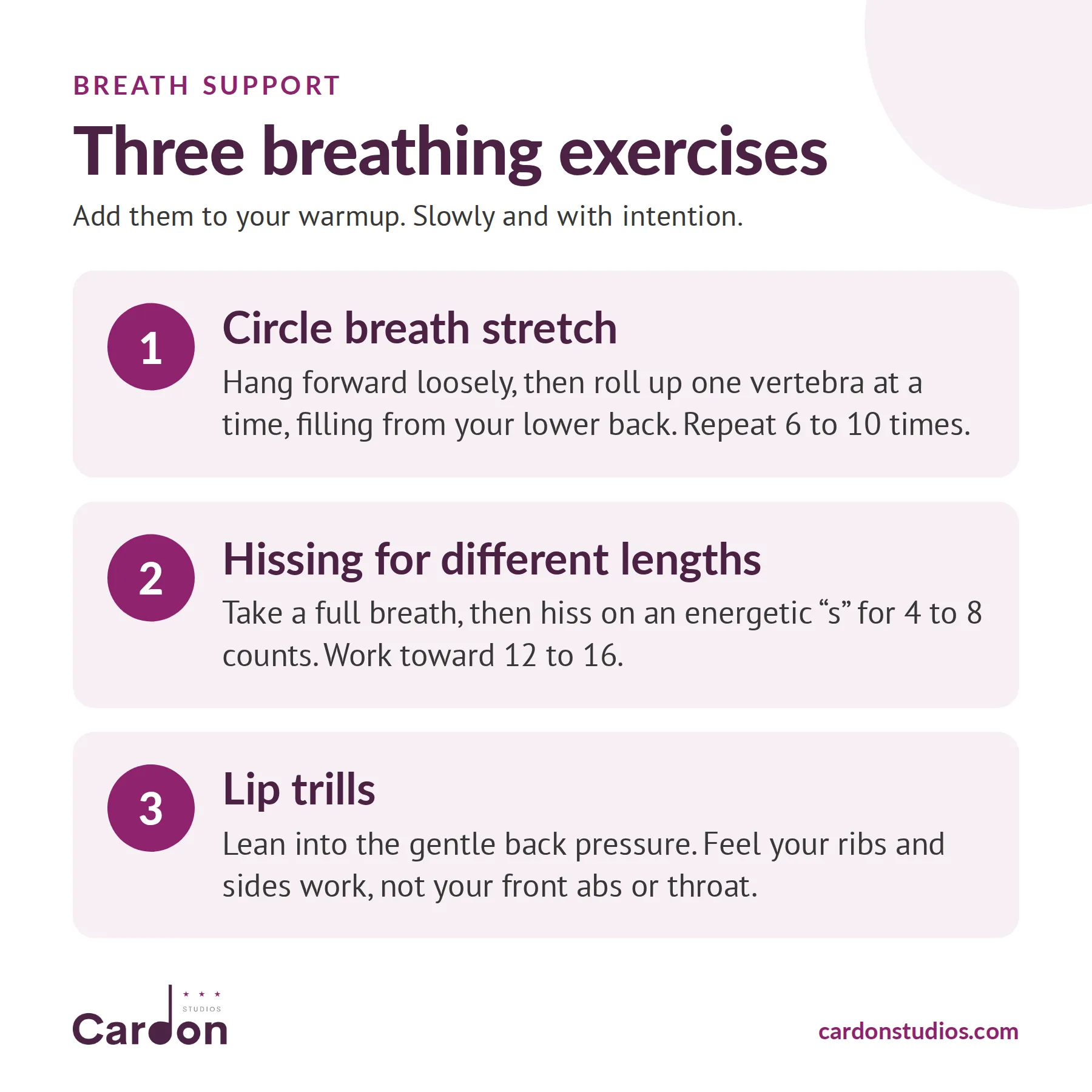
- Circle breath stretch (not to be confused with circular breathing): hang forward like a rag doll, bent at the waist, with your arms and neck loose. Slowly rise one vertebra at a time, breathing into your lower back and filling gradually until your chest feels full. Notice the stretch between your ribs. Exhale and fold forward to start again. Repeat slowly and with intention, 6 to 10 times.
- Hissing for different lengths: take a full breath, filling from your lowest ribs, then hiss out on an energetic “s.” Notice how a short phrase (4 to 8 counts) feels compared with a longer one (12 to 16 counts). Gradually work toward longer, slower hisses.
- Lip trills: often used as a vocal warmup, these are also a warmup for your body. Closing your lips creates gentle back pressure to lean against. Feel the engagement in your ribcage and sides, not your front abs or throat.
From the studio
Breath support is easier to adjust when someone can see and hear you. Cardon Studios lessons are recorded for your review, so you can rewatch exactly how your teacher demonstrated an exercise before you practice it on your own.
Want to go deeper? This book on breathing for singers is a good next step. For a simple routine to fit these exercises into, read how to practice singing between voice lessons, and see our guide to warming up.
Online voice lessons
Work on your breathing with a teacher
One monthly membership includes four private online voice lessons, one video coaching submission, the Learning Library, and member online events, with a teacher matched to your style, goals, age, and schedule.
Common questions about breathing for singing
What is breath support?
Breath support is the coordination that lets you release air steadily and efficiently while you sing, with the work happening low in your body rather than in your throat or shoulders. Different teachers and styles describe it differently, but that’s the shared goal.
Should my stomach move when I breathe to sing?
Some outward movement around your middle is normal as your diaphragm contracts. What you want to avoid is clenching your front abs or lifting your shoulders as you breathe in.
How do I stop running out of breath in long phrases?
Start with an open, relaxed posture and a low, wide breath, then practice releasing air steadily, for example with the hissing exercise above. Planning where you’ll breathe in your music helps too, and a teacher can help you find breath points that suit the song.