


Stage fright is easily the most common roadblock that keeps singers from sharing their art with the world. Even posting a prerecorded video can bring those familiar nerves flooding back. The good news is that stage fright responds well to practice, and the most reliable way through it is the one that sounds hardest at first: performing, again and again, in settings that build your confidence.
Key takeaways
- Stage fright is normal, and it usually eases as you perform more often, starting small.
- Slow breathing, in for four and out for four, helps your body settle before you sing.
- Rehearse the whole performance, including what you’ll do if something goes wrong.
- If anxiety is intense or persistent, talk to your doctor or a mental health professional.
Why your body reacts this way
When you sense danger, your sympathetic nervous system kicks into overdrive. Your heart rate rises, your breathing becomes shallow, and your attention narrows until it’s hard to think about anything but the feeling of being on alert. Those are not ideal conditions for nuanced, expressive music-making.
Nerves tend to show up in three ways at once. Physically, you might notice butterflies, a racing heart, or a dry mouth. Mentally, your inner critic gets louder and your thoughts race. Emotionally, you may feel afraid or wish you were somewhere else. Noticing which reactions you’re having is the first step to managing them, and like singing itself, handling nerves is a skill you build with practice.
That instinct exists for good reasons, but performing isn’t real danger. When you expose yourself to performing repeatedly, your system gradually learns to treat the experience as safe, and those fight-or-flight responses ease. That’s why facing your fear directly is such an important step, especially for newer performers.
A breathing tool for the moments before you sing
Until your mind and body are convinced that performing is safe, you can help your relaxed, parasympathetic nervous system take the lead. Slow your breathing on purpose: breathe in for a slow count of four, then out for a slow count of four, and repeat. Many singers find their heart rate settles as their breathing slows. As a bonus, it’s a good rehearsal for the steady breath control you want in performance.
This kind of conscious calming won’t erase every nerve, and it isn’t a substitute for professional support if you live with anxiety. But it’s a safe, simple first tool that helps many singers feel more in control. Our primer on breathing for singers goes deeper.
Build confidence by performing more often
Every performance makes the next one a little easier. Start small and build up:
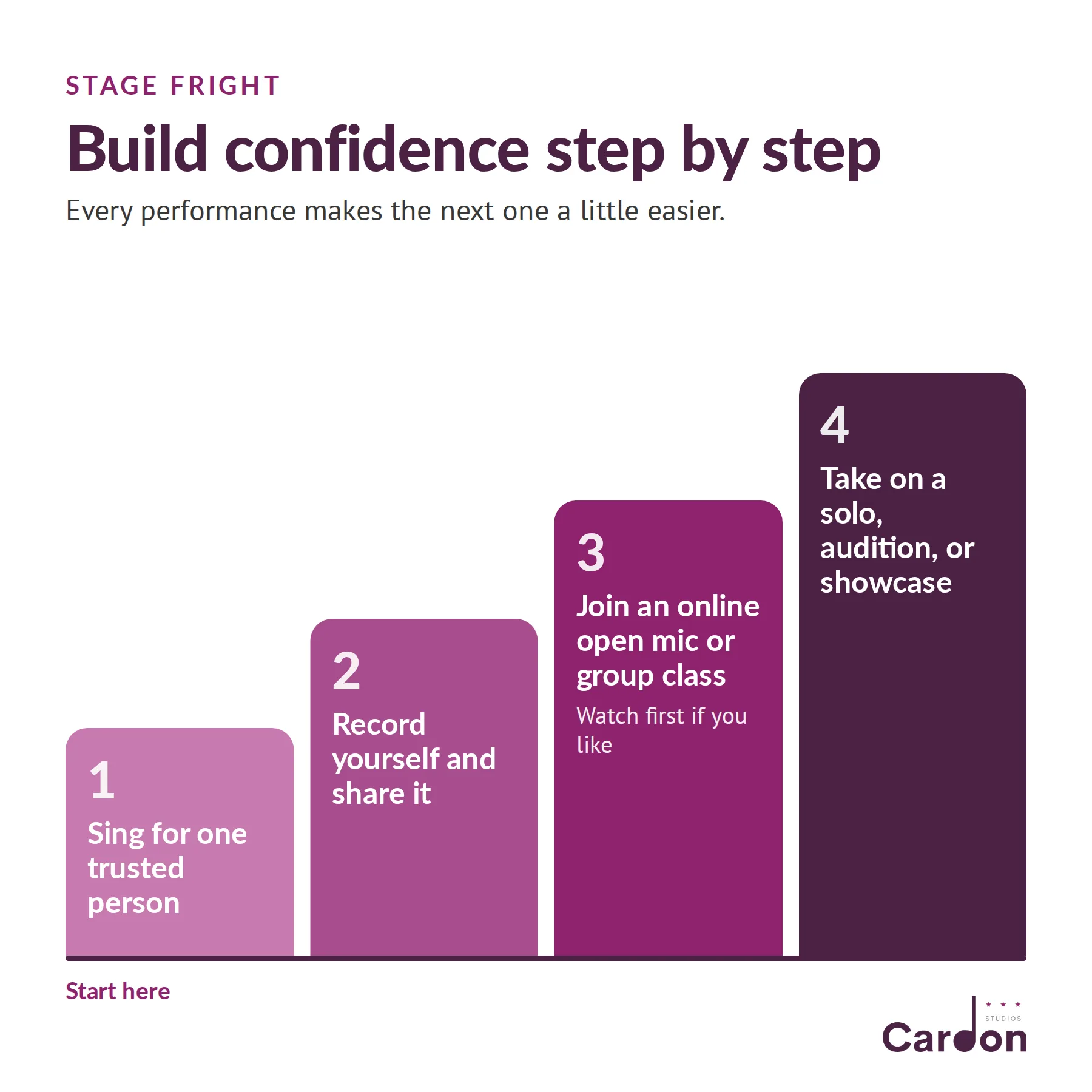
- Sing for one trusted person. A friend or family member is enough to start.
- Record yourself and share it. Record yourself, watch it back, then share the video with someone you trust.
- Join an online open mic or group class. You can observe first and perform when you’re ready.
- Take on a bigger moment. A solo, an audition, or a showcase.
Rehearse the performance, not just the song
Practicing technique is different from rehearsing a performance. In the weeks before you sing, run the whole piece the way you’ll do it on the day: from the top, standing, without stopping to fix things. Learn your song well enough that you aren’t relying on the page. The more securely you know it, the less room nerves have to work with.
- Record your run-throughs and watch them back as objectively as you can. Note what’s working, practice only the trouble spots, then run it again.
- Do a mock performance for a trusted friend or family member, and ask what they enjoyed and what could be clearer.
- Practice with distractions. Some athletes train with recorded crowd noise; you can rehearse with background sound or a friend in the room, so surprises on the day feel familiar.
Rehearse it in your head, too
Before you perform, walk through the song in your mind: the opening breath, the first line, and the moments you’ve worked on. Then make a short list of what-ifs, such as a forgotten lyric or a cracked note, and decide in advance what you’ll do. Usually the answer is to keep going and pick up at the next phrase. Having a plan for the unexpected makes it far less frightening.
It also helps to set a realistic goal. There’s no such thing as a perfect performance, which is good news: you can aim for a committed, expressive one instead.
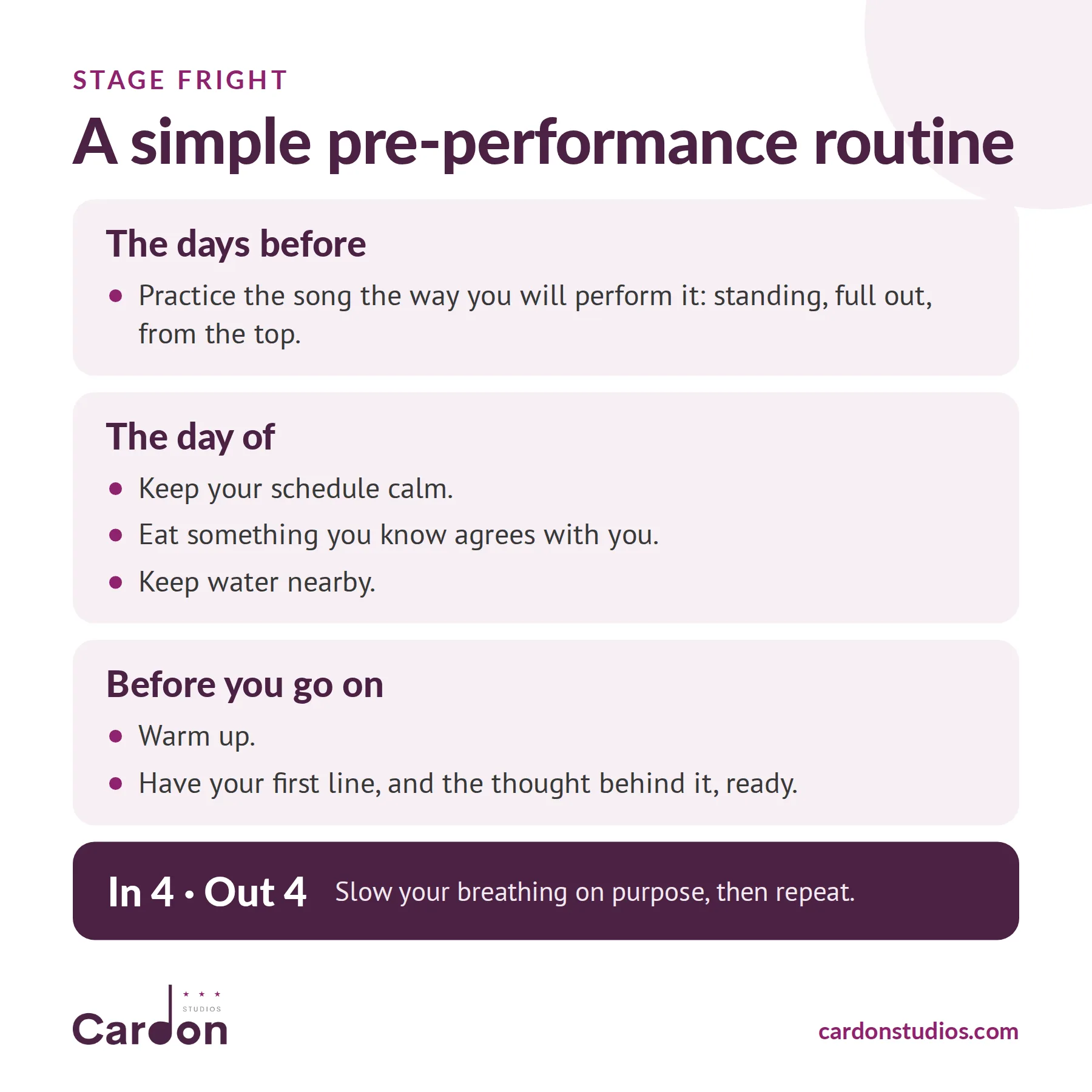
A simple pre-performance routine
Routines help because they give your mind something familiar to hold on to when everything else feels new.
- The days before: practice your song the way you’ll perform it, standing and full out from the top. See our guide to practicing between lessons for a simple session plan.
- The day of: keep your schedule calm, eat something you know agrees with you, and keep water nearby. Many singers avoid alcohol before performing.
- Before you go on: warm up, then use slow breathing. Have your first line, and the thought behind it, ready so you’re never starting from a blank.
Our article on performance preparation covers the days leading up to a show in more detail.
During and after the performance
Put your attention on the story you’re telling and the person you’re singing to, rather than on how you sound. If you make a mistake, keep going; audiences remember the recovery far more than the slip. Afterward, note one thing that went well and one thing to work on, and bring both to your next lesson.
When to talk to a doctor
Getting support
If performance anxiety is intense, persistent, or affecting your daily life, talk to your doctor or a mental health professional; there’s no shame in getting support. If you’re considering medication or any other remedy, ask your doctor how it might affect your voice as well as your nerves.
Working on nerves with a teacher
Performance anxiety is something you can work on directly in voice lessons. At Cardon Studios, you’re matched with a teacher by your style, goals, age, and schedule. Between lessons, you can send a video of yourself performing and get a personalized response from your teacher within 72 hours.
From the studio
Member online events, including open mic nights, group classes, and recorded showcases, give you a supportive room to practice performing. You’re welcome to simply watch first.
Facing an audition soon? Our guide to preparing for a musical theater audition includes more on handling nerves on the day.
Online voice lessons
Build confidence with a teacher behind you
One monthly membership includes four private online voice lessons, one video coaching submission, the Learning Library, and member online events, with a teacher matched to your style, goals, age, and schedule.
Common questions about stage fright
Is stage fright normal?
Completely. Most performers feel nervous at some point, including very experienced ones. The goal isn’t to feel nothing; it’s to feel steady enough to sing the way you’ve practiced.
Does stage fright ever go away?
For many singers it eases a great deal with regular performing. Even when some nerves remain, they tend to feel more manageable, and some performers come to experience them as useful energy.
Why does my voice shake when I’m nervous?
Shallow, rushed breathing and tension can make your voice feel unsteady. Slow breathing before you sing, a familiar warmup, and plenty of practice in performance conditions all help your voice feel more grounded.
How can I calm my nerves right before I sing?
Warm up, then breathe in slowly for a count of four and out for four, several times. Have your first line and the thought behind it ready, so you start from something familiar.