

An audition for a community theater production or a school musical is a short moment that takes real preparation. You might have a minute or less to show a director your voice, your sense of the character, and that you’ll be a good person to work with for the next few months. The good news: most of what makes an audition go well is in your control before you ever walk into the room.
Key takeaways
- Follow the audition notice exactly: what to sing, how long, and what to bring.
- Choose a song that shows what you do well, and make a cut that ends strongly.
- Directors cast characters, so act the song, not just sing it.
- Practice full out, get feedback before the day, and keep going if you slip.
Here’s how to prepare, step by step.
1. Read the audition notice closely
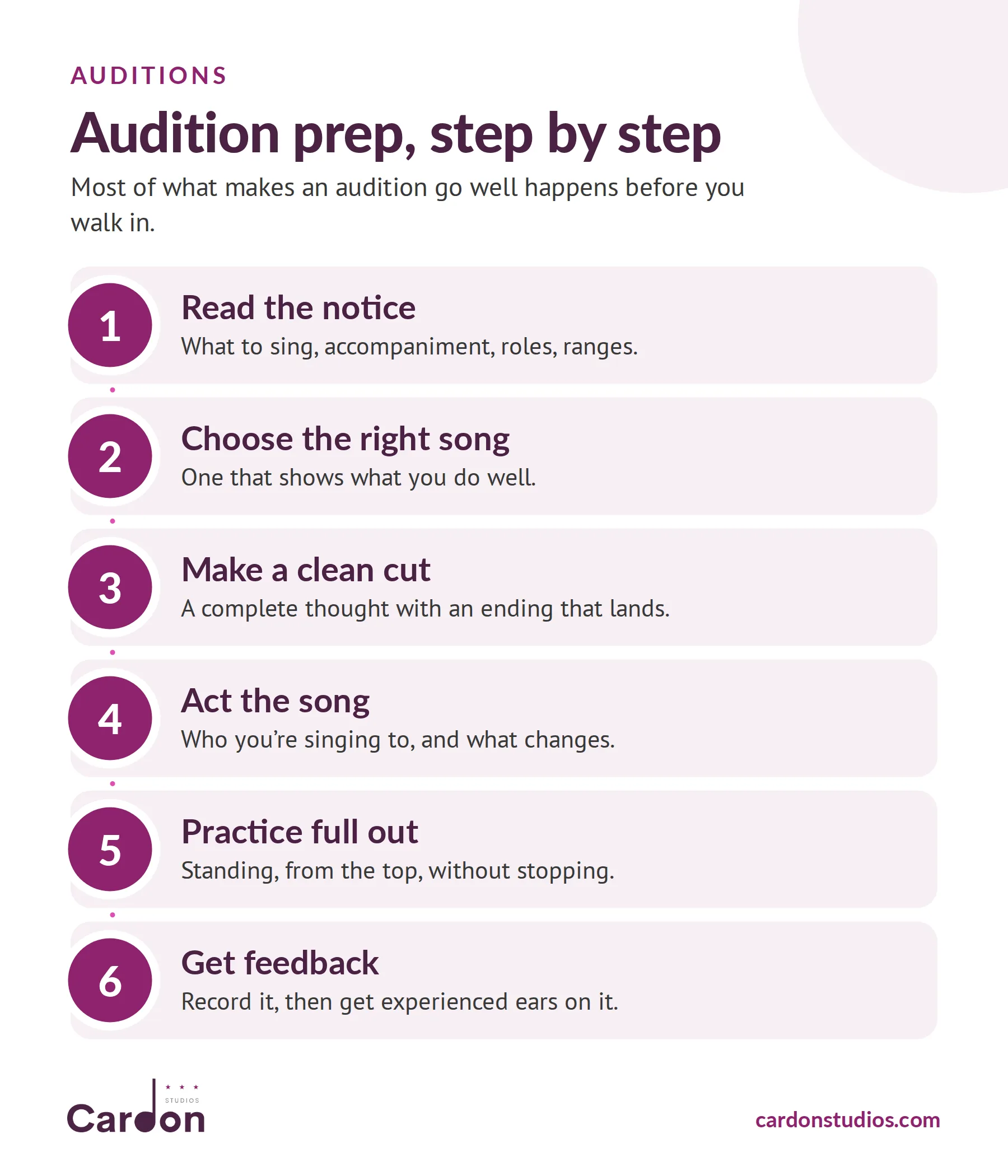
The notice tells you what the director wants, and following it is the first thing they’ll notice. Look for:
- What to sing: a 16-bar cut, a 32-bar cut, or a full song, and whether they want something in the style of the show.
- Accompaniment: whether there’s a live accompanist or you should bring a recorded track.
- Other parts of the audition: a reading from the script (often called “sides”), a dance call, or a callback date.
- Roles and ranges: the character descriptions and vocal ranges can help you decide which part to aim for and what to sing.
If something isn’t clear, it’s fine to ask the production team before the day.
2. Choose the right song
Pick something that shows what you do well and that you can sing confidently even on a nervous day. It should suit the style and era of the show without being an exact copy of what the director will hear from everyone else. Many directors prefer that you not sing from the show being cast unless the notice asks for it.
Our article on picking an audition song goes deeper on matching your song to the show and the role.
3. Make a clean cut
A 16-bar cut is short, usually well under a minute. The best cuts feel like a complete musical thought: a clear beginning, a moment that builds, and an ending that lands. Often that means starting near the end of the song and finishing on its final phrase.
If there’s a live accompanist:
- Bring printed sheet music in your key, in a binder or taped so the pages lie flat.
- Mark your start and end points clearly, and note any repeats, cuts, or tempo changes.
- Be ready to tell the accompanist your tempo in a few words or by quietly singing a line.
If you’re singing to a track, check the format the production wants, and have a backup copy.
4. Act the song
Directors are casting a character, not just a voice. Know who you’re singing to, what you want from them, and what changes by the end of your cut. Even a few specific choices, such as where you look and when the thought shifts, make a short audition far more memorable than a technically clean one with nothing behind it.
5. Prepare your voice in the weeks before
Practice your cut the way you’ll perform it: standing, full out, from the top, without stopping. Make a habit of warming up before you practice, not just on the day.
Many contemporary musical theater songs rely on a flexible mixed voice or a healthy belt. If that part of your range feels unreliable, our guides to finding your mix for higher voices and lower voices are a good place to start, and it’s worth working on with a teacher well before the audition.
6. Get feedback before the day
It’s hard to judge your own audition from the inside. Recording yourself is the simplest way to see what the director will see. Better still, get experienced ears on it. Cardon Studios members can upload a video of their audition cut and get a personalized response video from their teacher within 72 hours, with specific notes on the voice, the acting, and the choices in the cut.
Singing for real people helps too. Member open mic nights, held online, are a low-pressure place to try your audition song in front of a supportive room before it counts.
7. Handling nerves
Nearly everyone is nervous at an audition. A few things help: a familiar warmup routine, slow breaths before you walk in, and a clear first thought for the opening line so you’re not starting from a blank. For more, read our article on managing stage fright.
8. On the day
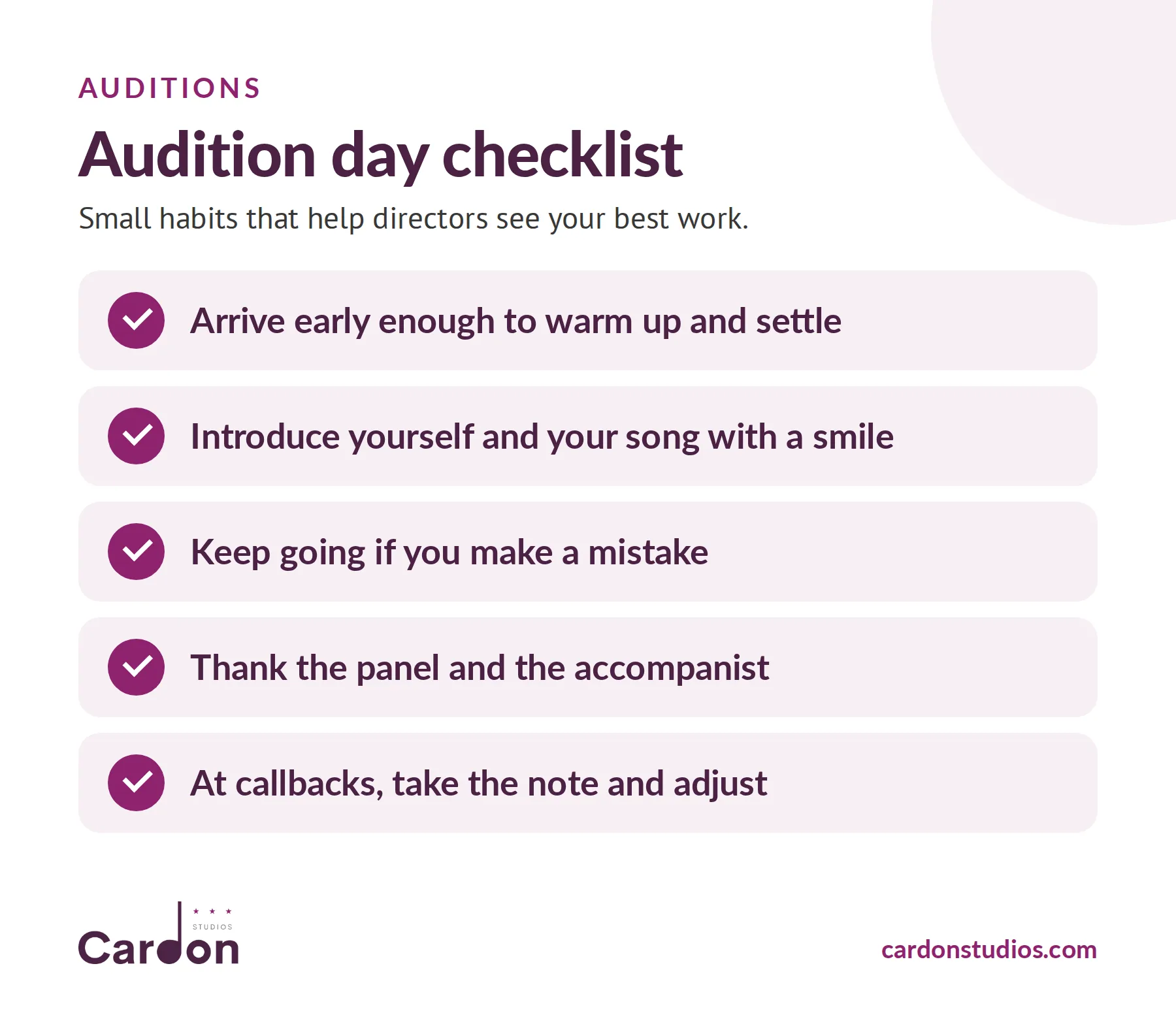
- Arrive early enough to warm up and settle.
- Introduce yourself and your song simply and with a smile.
- If you make a mistake, keep going. Directors care far more about how you recover than about a missed word.
- Thank the panel and the accompanist on your way out.
If you’re called back, you may be asked to sing from the show, read with other actors, or try a direction the director gives you on the spot. Being able to take a note and adjust quickly is one of the things callbacks are designed to see.
A note for parents of young performers
School and community musicals are often a young singer’s first audition. The most helpful things a parent can do are to help your singer read the notice carefully, give them time and space to practice their cut, and keep the focus on preparation and enjoyment rather than on the casting decision. Cardon Studios works with singers ages 10 and up; for singers under 18, a parent or guardian creates the account and pays for the membership. Our parent’s guide to voice lessons covers what’s included.
How voice lessons help with auditions
Rehearsal and auditions are about the production; a private lesson is the one place the work is about your voice: the audition cut, the high note you’re not sure of, the breath before the big phrase. At Cardon Studios, you’re matched with a teacher by your style, goals, age, and schedule, and you’re welcome to bring your audition material to every lesson.
- A teacher who listens to your voice. Four private online voice lessons each month, live and one-on-one.
- Support between lessons. Send a video of your audition cut and get a personalized response from your teacher within 72 hours. Practice with warmups, exercises, and Vocal Pathways in the Learning Library, and rewatch your lessons in your student account.
- A place to sing. Online open mics, group classes, and recorded showcases where you can try material in front of a supportive room, or observe first if you like.
Online voice lessons
Walk into your audition prepared
One monthly membership includes four private online voice lessons, one video coaching submission, the Learning Library, and member online events, with a teacher matched to your style, goals, age, and schedule.
Common questions about musical theater auditions
How long is a 16-bar audition cut?
Usually well under a minute, depending on the tempo of the song. What matters most is that it feels complete and ends strongly.
Should I sing a song from the show I’m auditioning for?
Only if the audition notice asks for it. Otherwise, choose a song in a similar style that shows off your voice and your acting.
Can I prepare for a live audition with online lessons?
Yes. Lessons are live and one-on-one, so you can work on your cut, your acting choices, and your nerves with your teacher, then send a video of a run-through for detailed feedback. You’ll need a computer, tablet, or phone with a camera and microphone, an internet connection, and a quiet place to sing.