

Singing in a choir is one of the great joys a singer can have: standing inside a wall of sound, holding your line while the harmonies move around you. It also asks things of your voice that solo singing doesn’t. You often can’t hear yourself, you’re asked to blend rather than stand out, and a long rehearsal can leave you tired in a way that singing at home never does.
This guide covers the four challenges choral singers ask us about most, what you can do about each one, and where individual help fits in.
Key takeaways
- Blend comes mostly from matching vowels, not from singing timidly.
- When you can’t hear yourself, learn to sing by feel instead of pushing.
- Comfortable volume comes from coordination, and clear diction stays quick and light.
- Private lessons add to choir: they’re the one place the work is about your voice.
Why choir singing is its own skill
Rehearsal is about the ensemble. Your director is balancing sections, shaping phrases, and preparing a concert, so there is rarely time to work on one singer’s breath, range, or tone. That isn’t a flaw in choir; it’s what choir is for. A private lesson is the one place the work is about your voice: the passage you can’t quite land, the high note in your line, the breath before the long phrase.
1. Blending without disappearing
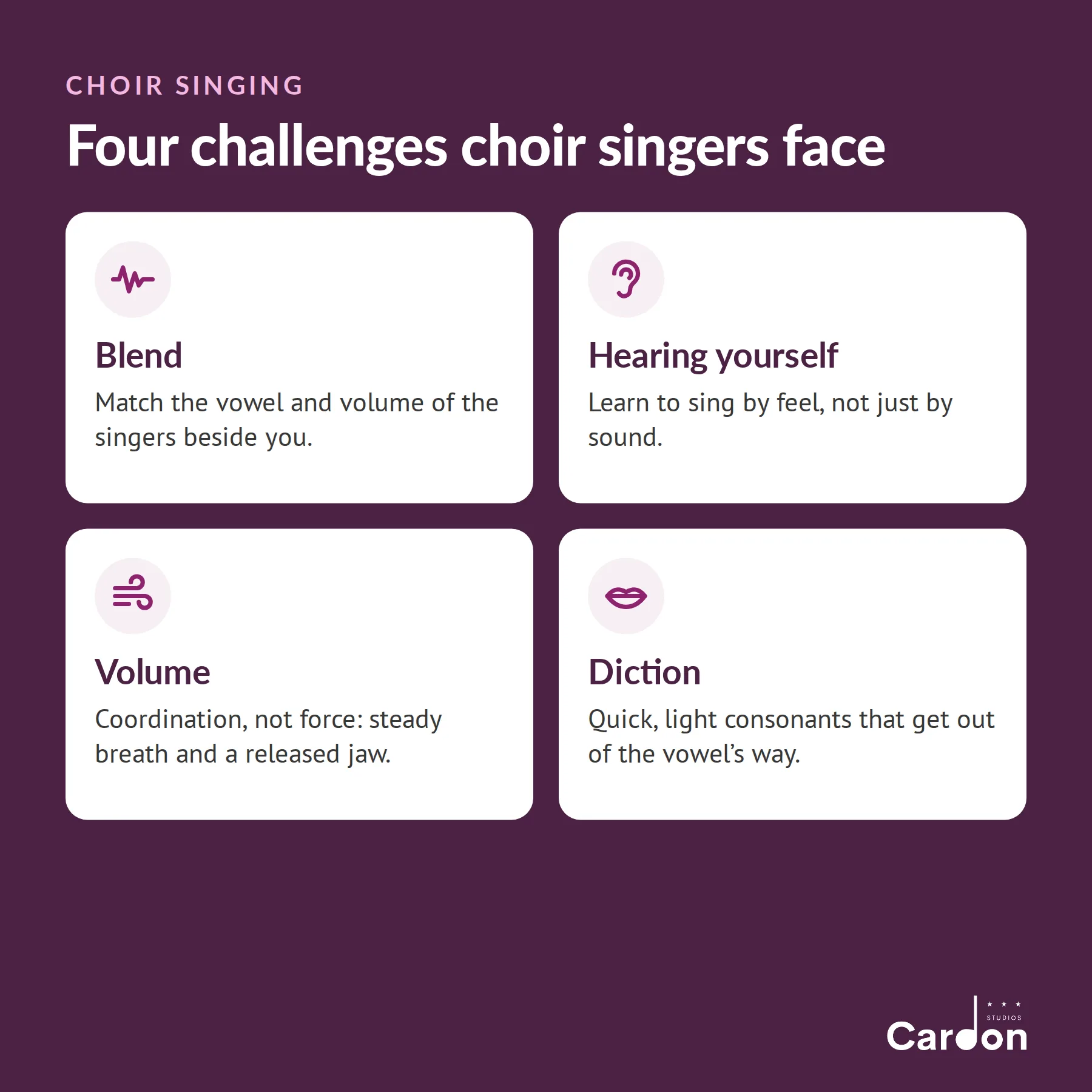
The goal of choral singing is an even, unified sound, with no single voice sticking out. Much of that blend comes from vowels. When everyone in a section shapes the same vowel the same way, the voices lock together, which is why directors spend so much rehearsal time on them.
Blending doesn’t mean singing timidly or holding back your breath. Singers who try to hide often end up under-supported and drifting flat. Aim to match the vowel and volume of the singers beside you while keeping your breath moving.
Try this: sing a phrase from your choir music on a single vowel, then again on the written words, and notice whether the shape of your mouth stays consistent. In lessons, a teacher can help you hear and control different vowel colors so you can adjust quickly when your director asks.
2. When you can’t hear yourself
In a full choir, especially for higher voices, it can be hard to hear your own sound. Many singers respond by pushing harder or tightening, often in the jaw or throat, to get more feedback. That extra effort adds up over a rehearsal and is a common source of vocal fatigue.
A more reliable approach is to learn to sing by feel. When you know what efficient, comfortable singing feels like in your body, you don’t need to hear every note to trust it.
Try this: record yourself singing your part alone at home, then listen back. Recording yourself shows you what you actually sound like, which is exactly the information you’re missing in a full room.
3. Singing out without strain
Competing with the voices around you, particularly in order to hear yourself, is a common way to tire your voice quickly. Comfortable volume comes from coordination rather than force: steady breath, a released throat and jaw, and resonance doing the work. “Breath support” is the term you’ll hear most, and it can feel a little different for every singer, which is why it helps to have a teacher look at your own setup.
For the basics, read our primer on breathing for singers, and make a habit of warming up before rehearsal rather than letting the first twenty minutes of rehearsal be your warmup.
4. Clear diction without overworking
Diction is the other thing directors come back to again and again, and for good reason: the audience needs to understand the words. Enunciation comes from your articulators, which are your lips, teeth, and tongue. Eager singers sometimes overdo it, clamping down on consonants or tensing the jaw to be understood. Voices work better, and sound better, when they aren’t carrying extra load.
Clean diction is quick and light. Consonants happen at the front of the mouth and then get out of the way of the vowel. A voice teacher can help you find that balance and release tension you may not know you’re carrying.
Finding your part
Choirs usually divide voices into soprano, alto, tenor, and bass, often with further divisions inside each section. Singing in the right section matters: a part that sits too high or too low for long stretches is tiring, however well you sing. If you’re not sure where your voice fits, our guide to voice types and vocal range is a good starting point, and a teacher can help you understand your comfortable range before a placement or audition. Struggling to stay on your line? Read how to hold your harmony part.
Auditioning for a solo or a new choir
Solo and choir auditions are a chance to show your own voice, which can feel very different after months of blending. Choose material that shows what you do well, practice it the way you’ll perform it, and get outside ears on it before the day. Our article on picking an audition song covers how to choose.
When to rest, and when to see a doctor
Listen to your voice
Some tiredness after a long rehearsal is normal. If you regularly feel hoarse, strained, or sore after choir, that’s a sign to look at how you’re singing and to talk with your director or a voice teacher. If hoarseness, pain when you sing, or loss of voice doesn’t clear up with rest, see a doctor or an ear, nose, and throat specialist. A voice teacher can help with technique, but not with a medical problem.
Signs a voice lesson would help your choir singing
Plenty of choir singers never take a private lesson, and that’s fine. Lessons tend to help most when something specific is getting in your way, or when you’re ready for the next step.
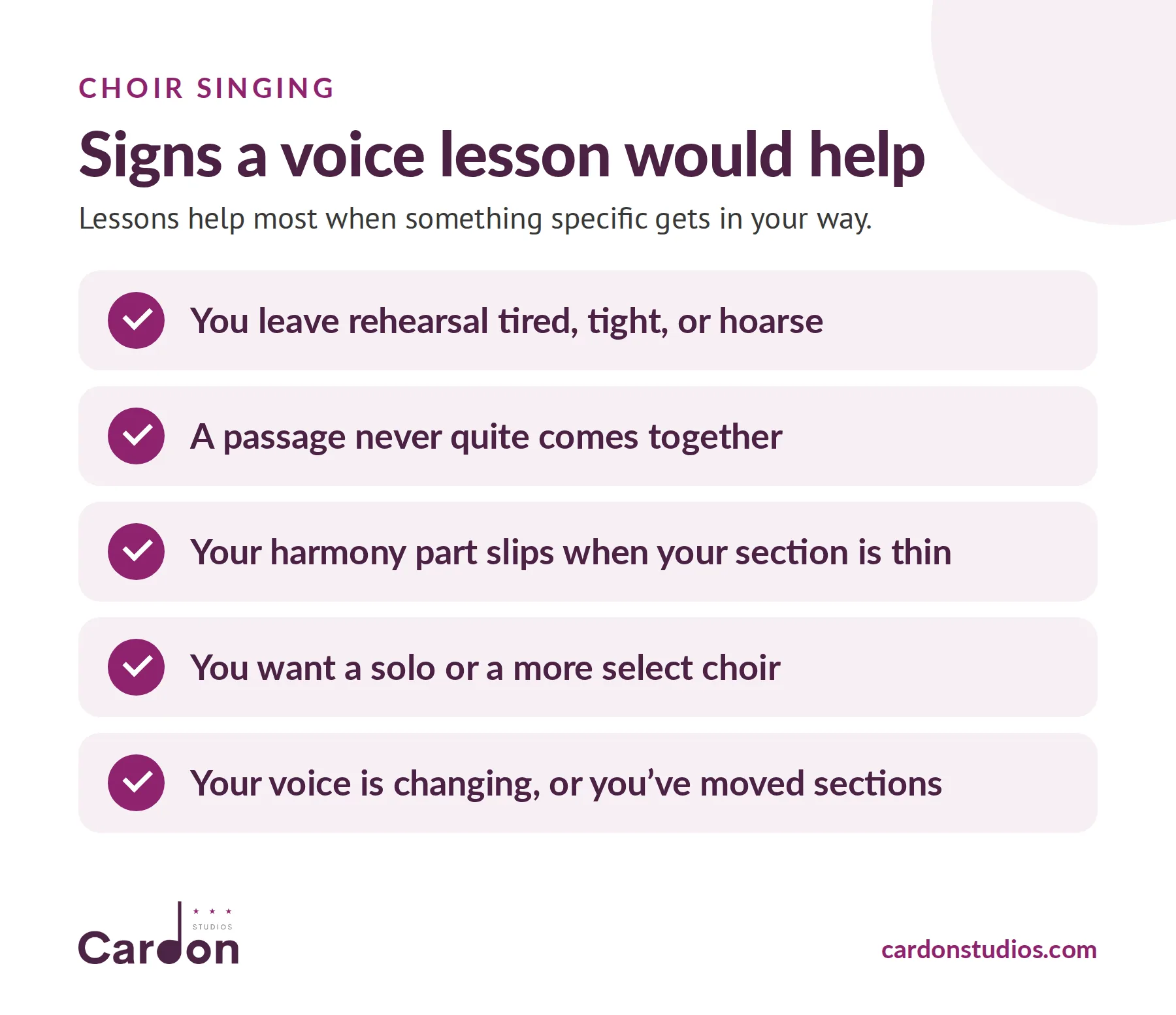
- You often leave rehearsal feeling tired, tight, or hoarse.
- A particular passage, usually a high, low, or long one, never quite comes together.
- You struggle to hold your harmony part when your section is thin.
- You’d like a solo, or you’re auditioning for a more advanced or select choir.
- Your voice is changing, or you’ve been moved to a new section.
- You want to understand your own voice better.
What a voice lesson looks like for a choir singer
A lesson starts with a check-in: what’s been going well, and what’s been hard in rehearsal. From there, your teacher may use targeted exercises for the skill a tricky passage needs, such as a smoother move into your upper range or steadier breath through a long phrase, and then bring that work straight into your choir music. You’ll leave with a clear plan for practice before your next rehearsal.
Between lessons, you can record yourself practicing your part and send the video to your teacher, who responds with a personalized video within 72 hours.
How private lessons fit alongside choir
Voice lessons don’t replace choir; they add to it. At Cardon Studios, you’re matched with a teacher by your style, goals, age, and schedule, and lessons are built around your voice and what you’re working on. You’re welcome to bring your choir music and work through the passage that keeps catching you.
- A teacher who listens to your voice. Four private online voice lessons each month, live and one-on-one.
- Support between lessons. Send a video of a tricky passage and get a personalized response from your teacher within 72 hours. Practice with warmups, exercises, and Vocal Pathways in the Learning Library, and rewatch your lessons in your student account.
- A place to sing. Online open mics, group classes, and recorded showcases where you can try material in front of a supportive room, or observe first if you like.
From the studio
Kate Cardon taught music in K–12 classrooms before founding Cardon Studios in 2010. Classroom and ensemble teaching showed her how much a singer can grow with individual attention, and how rarely there is time for it in a rehearsal. Today she leads the studio, selects and trains its teachers, and matches each singer with the right one.
Online voice lessons
Bring your choir music to a lesson
One monthly membership includes four private online voice lessons, one video coaching submission, the Learning Library, and member online events, with a teacher matched to your style, goals, age, and schedule.
For choir directors
If you direct a community, church, or school choir and think this guide would help your singers, you’re welcome to share it.
Common questions from choir singers
Do I need voice lessons if I’m already in a choir?
Not to enjoy choir, no. Lessons help when you want something specific: more comfortable range, less fatigue after rehearsal, confidence for a solo, or preparation for an audition.
Can online lessons help with choir music?
Yes. Lessons are live and one-on-one, so you can bring your choir part and work through it with your teacher. You’ll need a computer, tablet, or phone with a camera and microphone, an internet connection, and a quiet place to sing.
Are lessons available for teenage choir singers?
Yes. Cardon Studios works with singers ages 10 and up. For singers under 18, a parent or guardian creates the account and pays for the membership. Parents can read more in our parent’s guide to voice lessons.