


You know your part at home. Then rehearsal starts, the sopranos come in with the melody, and before you know it you’re singing their line instead of yours. If that sounds familiar, you’re in good company: holding a harmony part is one of the most common challenges choir singers face. The good news is that it’s a skill, and skills can be practiced.
Key takeaways
- Harmony parts slip because the melody is louder and nearby voices pull you off your line.
- Learn your part securely before rehearsal, then practice it against the other parts.
- In rehearsal, listen for your own section first, and rejoin at a phrase you’re sure of if you get lost.
- Ear-training habits, like singing against a held note, make your line steadier over time.
Why harmony parts are hard to hold
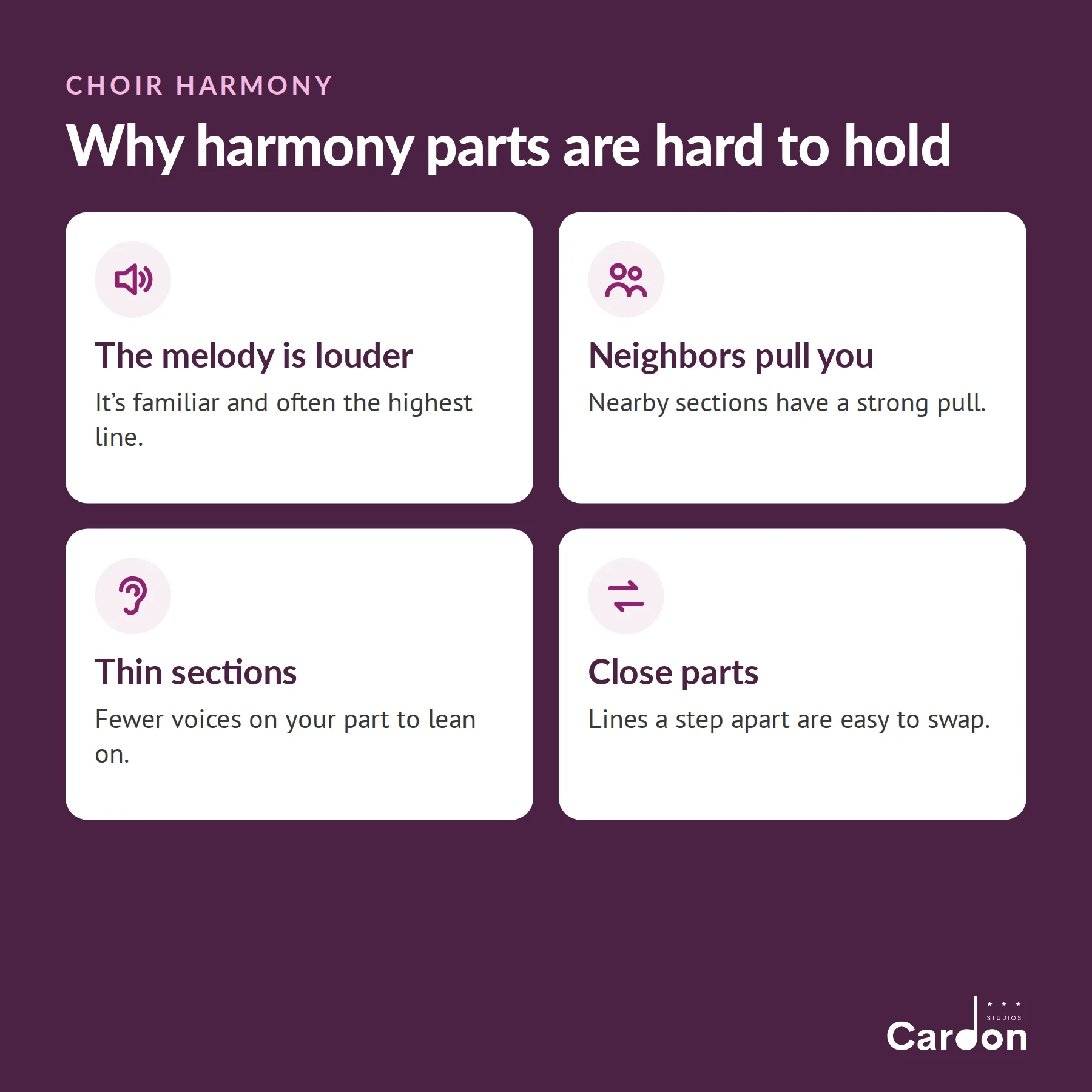
- The melody is louder in your ear. It’s usually the most familiar line and often the highest, so it cuts through.
- You’re standing near another section. The voices closest to you have a strong pull.
- Your section is thin. With fewer voices on your part, you have less to lean on.
- Your part moves close to another line. When two parts are only a step apart, it’s easy to slide onto the wrong one.
Learn your part before rehearsal
Rehearsal is the hardest place to learn a part for the first time. The more secure you are before you arrive, the easier it is to hold your line.
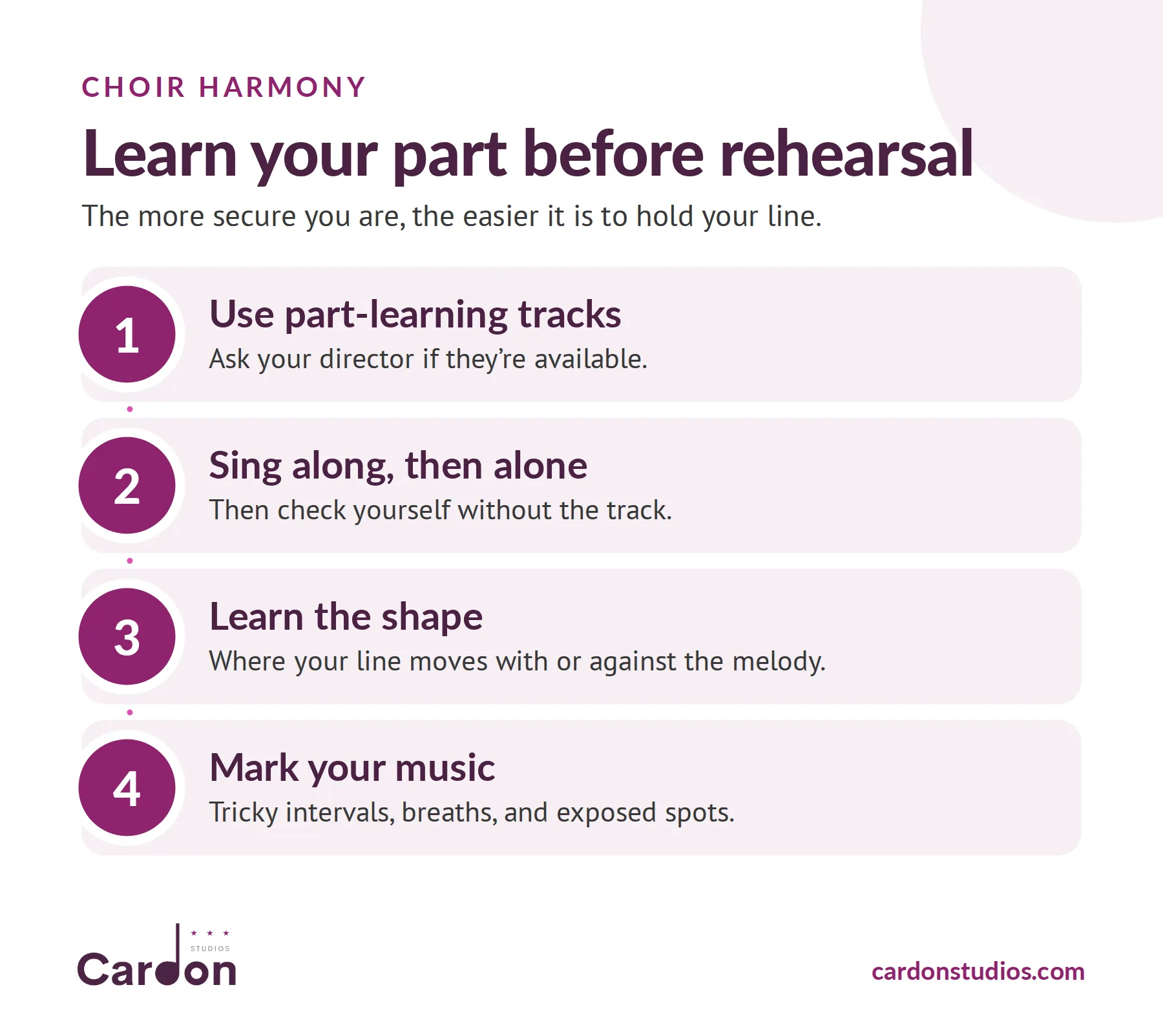
- Use part-learning tracks if your choir provides them, or ask your director whether they’re available.
- Sing along, then alone. Start by singing with the track, then try the same passage without it and check yourself.
- Learn the shape. Notice where your part moves in the same direction as the melody, where it moves against it, and where it holds still.
- Mark your music. Circle the tricky intervals, mark your breaths, and note where your part is exposed.
A keyboard or a note-playing app on your phone can help you check starting pitches and difficult intervals. If reading music feels shaky, our article on musicianship for singers is a good place to start.
Practice against the other parts
Once you know your part on its own, practice it while hearing the others. Sing your line along with a recording of the full piece, or with a track of the melody alone. It will feel harder at first, which is the point: you’re rehearsing the exact situation that trips you up in rehearsal.
You can also record yourself singing your part, then play your recording against the full piece to hear whether you stayed on your line.
Practice ideas for a stronger ear
- Sing against a held note. Hold your starting note or the key’s home note on a keyboard or app, and sing your line against it so you hear each interval clearly.
- Sing with the melody quietly underneath. Play the melody at a low volume while you sing your part, then turn it up as you get more confident.
- Isolate the leaps that trip you up. Sing the tricky interval slowly several times, then put it back into the phrase around it.
In rehearsal
- Listen for your section first, not the melody. Tune your ear to the voices singing your line.
- Ask about where you stand. Standing next to a confident singer in your section can make a real difference.
- Find your starting note from what’s around you, such as the accompaniment or another part you know relates to yours.
- If you get lost, stop and listen. Rejoin at the next entrance or phrase you’re sure of, rather than guessing.
When your section is thin
With only a few voices on your part, it’s tempting to sing more quietly so mistakes are less noticeable, but under-supported singing is more likely to drift. Learn your part thoroughly before rehearsal, mark your entrances clearly, and sing with steady breath and confidence. If you can, stand next to the strongest singer on your part, and let your director know if your section is consistently thin; they may be able to rebalance parts or seating.
After rehearsal
The few minutes after rehearsal are a good time to lock in what you learned. While it’s fresh, mark any spots where you lost your line, note what pulled you off it, and add a pencil reminder in your music, such as an arrow for the direction your part moves or the note you can find your entrance from. Next time you practice, start with those spots.
Blend, volume, and your own voice
Holding your part is easier when you’re singing efficiently. Pushing to hear yourself adds strain and can pull you off pitch. Our guide to singing in a choir covers blend, hearing yourself, volume, and diction in more detail, and our guide to voice types can help if you’re unsure whether your part suits your range.
How voice lessons help
A private lesson is the one place the work is about your voice and your line. You can bring your choir music to a Cardon Studios lesson and work through the intervals and passages that keep catching you, with a teacher matched to your style, goals, age, and schedule.
From the studio
Between lessons, you can send a video of yourself singing your part and get a personalized response from your teacher within 72 hours.
Online voice lessons
Bring your choir part to a lesson
One monthly membership includes four private online voice lessons, one video coaching submission, the Learning Library, and member online events, with a teacher matched to your style, goals, age, and schedule.
Common questions about choir harmony
Why do I keep drifting to the melody?
The melody is usually the most familiar and prominent line, so your ear naturally follows it. Learning your part securely on its own, then practicing it against the melody, trains your ear to stay put.
How can I learn my choir part faster?
Short, regular practice with a part-learning track, marking the tricky spots in your music, and checking yourself without the track all help. So does working on basic music-reading skills.
Is it normal to find harmony hard?
Very. Almost every choir singer has struggled with it at some point. It gets easier with practice and a more confident sense of how your part fits with the others.