

Performing in a recital or showcase gives singers a deadline that focuses practice, real experience handling nerves, the chance to learn from other singers, and a confidence boost that carries into every future performance. You don’t need a big stage to get these benefits. An open mic, a studio showcase or a recorded performance shared with family all count. Here’s what performing does for your singing, which opportunities to look for, and how to prepare.
Key takeaways
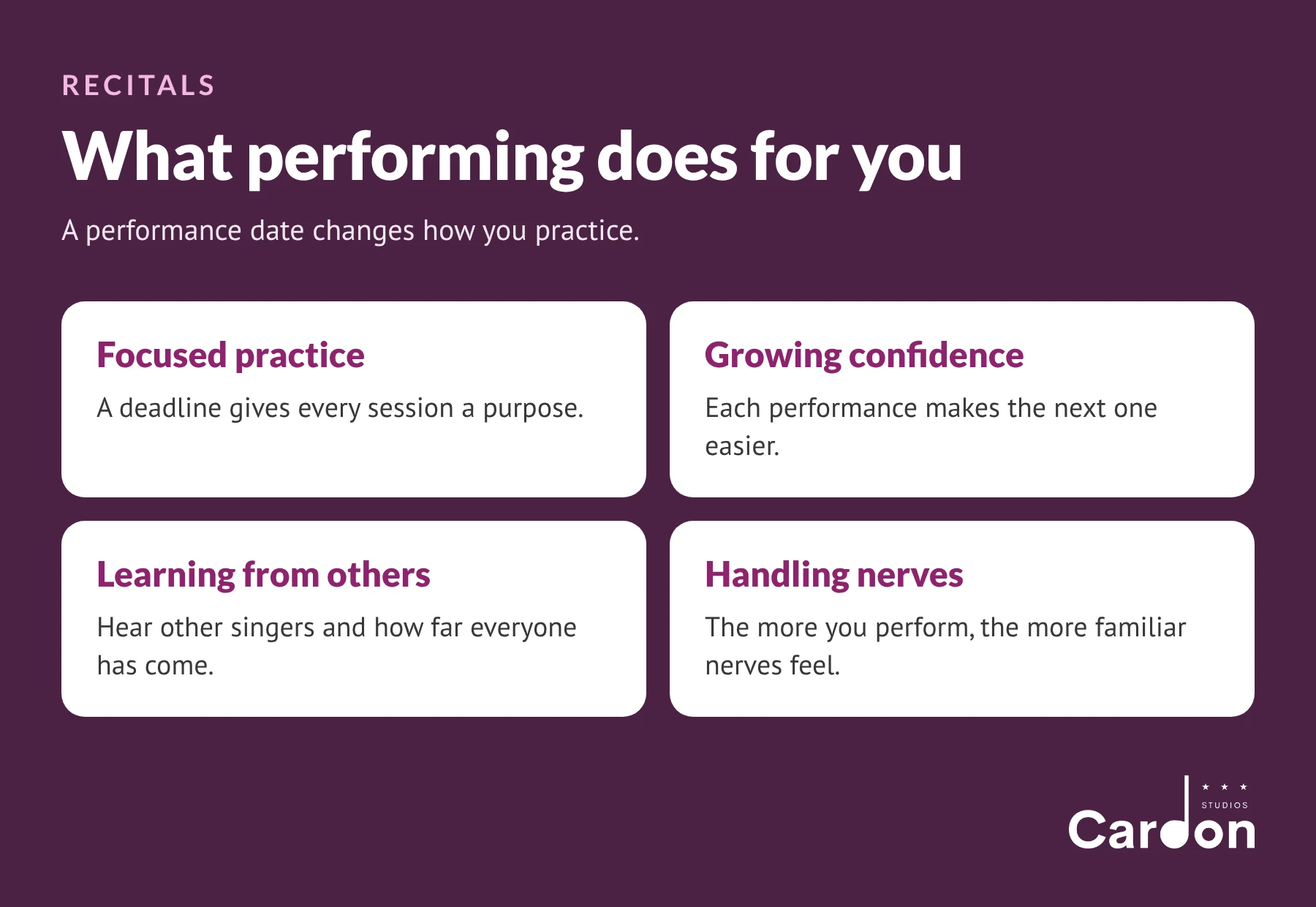
- A performance date gives your practice urgency and direction.
- Confidence grows with every performance, and nerves get easier to manage.
- Hearing other singers inspires you and shows how far everyone has come.
- Start small, with an open mic or a recorded showcase, and build from there.
Why perform at all?
Recitals and showcases are a vital part of learning to sing, and many students consider them the highlight of their experience. Practicing in your room builds skill, but performing for others shows you how that skill holds up when it counts. Giving an effective performance is a skill in its own right, and the only way to build it is to do it.
Performing does take courage, and it works best when singers are encouraged rather than forced. Despite the hard work, most singers find it one of the most rewarding parts of their training.
Six benefits of performing in a recital
1. A deadline that focuses your practice
Singers with a performance to look forward to feel a healthy sense of urgency. They practice more often and with more purpose, and they’re eager to absorb everything their teacher offers. Better still, that rhythm often becomes a habit that continues after the recital. For a simple structure, see how to practice singing between lessons.
2. Confidence that grows with each performance
Performing in front of people isn’t easy, but each time you do it, you gain experience for the next one. Starting early, in low-pressure settings, builds confidence that lasts.
3. Learning from other singers
Recitals let you hear your fellow singers. Beginners see how far they’ve come since their first lesson, and everyone gets to hear more experienced performers. That’s inspiring, and it’s motivation to keep practicing.
4. Practice handling nerves
Nerves are a normal part of performing. The more often you perform, the more familiar the feeling becomes, and the better you get at singing through it. Our guide to conquering stage fright has techniques that help.
5. Honest feedback on your progress
A performance shows you which parts of a song hold up under a little pressure and which need more work. That’s valuable information to bring back to your lessons.
6. A real sense of accomplishment
After the work of preparing, performing gives a great sense of pride. You face your nerves head on, and at the end there’s applause and the satisfaction of having shared something you worked hard on. That boost, at any age, leaves a mark.
Types of performance opportunities
| Opportunity | Good for |
|---|---|
| Open mic night | Casual, low-pressure performing and trying new material |
| Recorded showcase | Presenting a polished song that family and friends can watch from anywhere |
| Studio recital | Performing a prepared piece for a supportive audience |
| Choir concert | Building stage experience as part of a group |
| Community theater or school musical | Combining singing, acting and movement on a real stage |
| Singing for family or friends | The easiest first step, at home or on a video call |
If you’re new to performing, start with the lowest-pressure option and work up. If you’re auditioning for a show, see our guide to community theater and school musical auditions.
How to prepare for a recital or showcase
- Choose a song you can own. Pick something that sits comfortably in your voice and that you love singing. Ease beats difficulty on stage.
- Set a timeline. Count back from the performance date and plan when you’ll learn, memorize and polish the song.
- Memorize early. Have the song memorized well before the performance so you can focus on expression. Our guide to memorizing a performance piece can help.
- Practice performing. Sing for a family member, a friend or your phone camera, start to finish, without stopping.
- Plan the details. Decide how you’ll walk on, where you’ll look, how you’ll start and how you’ll take your bow.
- Warm up on the day. Keep it gentle, and leave your voice fresh. Try our vocal warm-up routine.
- Reflect afterward. Note what went well and one thing to work on next, and bring it to your next lesson.
For a fuller guide, read how to prepare for a singing performance.
On the day of your performance
- Get a good night’s sleep and eat a light meal a few hours before you sing.
- Drink water through the day, and avoid shouting or talking loudly beforehand.
- Do a gentle physical and vocal warm-up, and sing your opening phrase once.
- Arrive or log on early so you’re not rushed. For online events, test your camera and sound.
- Take a few slow, low breaths before you start.
- Focus on the story of the song, not on being perfect.
For online performances, set up good lighting in front of you, a quiet room and a stable internet connection. Our guide to optimizing audio for Zoom covers the sound side.
After the performance
Take a moment to enjoy it. Then, once the adrenaline has faded, think back honestly. What felt good? What would you do differently? If you have a recording, watch it with curiosity rather than judgment. Rest your voice if it feels tired, and bring your notes to your next lesson. Then pick your next performance date, so the momentum continues.
A note for parents
For young singers, recitals and showcases can be a powerful confidence builder. Students do best when they’re encouraged to take part rather than pushed. Celebrate the effort and the courage, not just the result, and let your child choose music they’re excited to share. Our parent’s guide to voice lessons for kids and teens has more ideas for supporting a young singer.
From the studio
Every Cardon Studios membership includes member online events. Open mic nights are live on Zoom, casual and low-pressure, and perfect for trying new material. Student showcases are pre-recorded, so you can present polished work to a wider audience, including family and friends who can tune in from anywhere.
Online voice lessons
Get ready for your next performance
One monthly membership includes four private online voice lessons, one video coaching submission, the Learning Library, and member online events, with a teacher matched to your style, goals, age, and schedule.
Common questions about recitals
Why are recitals important for singers?
They give your practice a goal, build confidence, help you learn to manage nerves and let you hear other singers. They also show you how your singing holds up under a little pressure.
What should I sing at my first recital?
A song you love that sits comfortably in your voice and that you can sing with ease. Save showpieces for later; a confident, comfortable performance is far more satisfying.
How do I stop being nervous before a recital?
Prepare thoroughly, practice performing for others beforehand, and use calming routines such as slow, low breathing before you go on. Nerves are normal, and they usually ease with experience.
Do online showcases count as performing?
Yes. A recorded or live online performance still asks you to prepare, commit and share your singing with an audience, and it builds the same skills.
How often should singers perform?
There’s no fixed rule, but regular, low-pressure chances to perform, such as a monthly open mic or singing for family, help nerves fade and keep your practice focused. Add bigger performances as your confidence grows.
What if I make a mistake during a performance?
Keep going. Most audiences won’t notice small slips, and recovering calmly is part of performing. Note it afterward and work on it in your next lesson.